
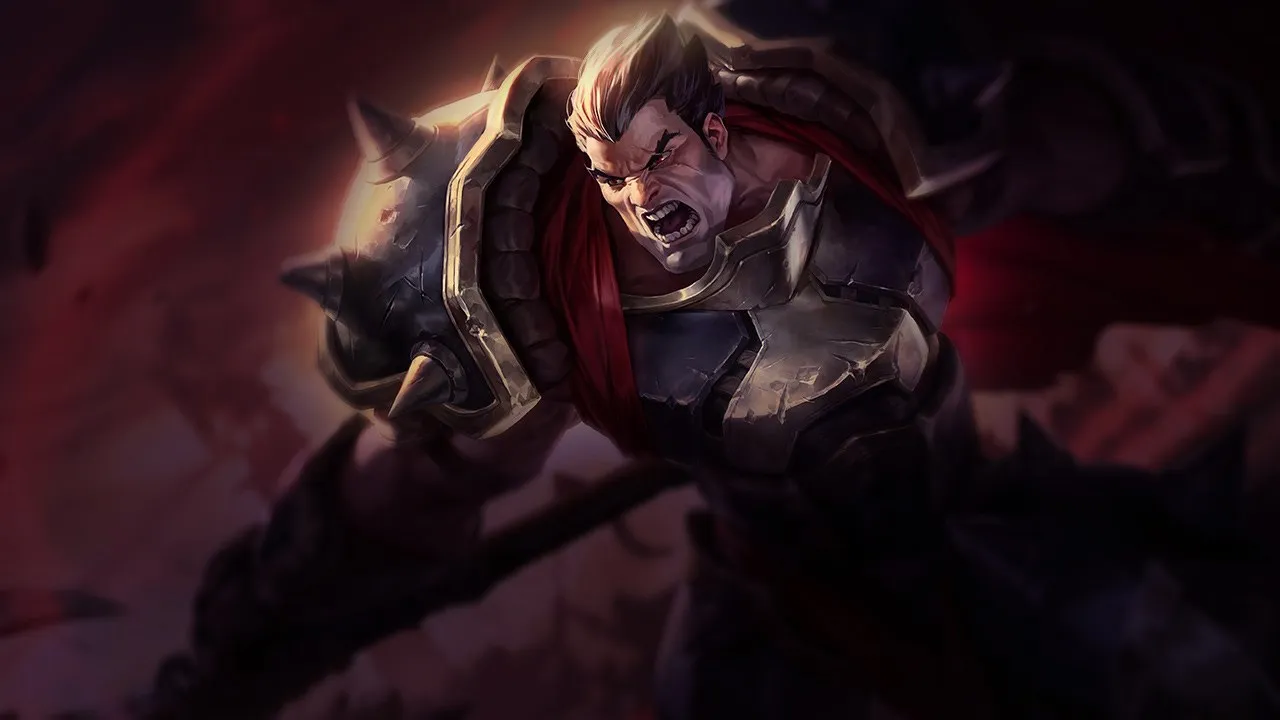
Mastering the Juggernaut: The Art of Forcing Engagements
Juggernauts are champions designed to deal sustained damage and soak up punishment in melee combat, but they inherently lack mobility and reliable engagement tools. Their strength lies in their ability to become an unavoidable threat, forcing opponents to initiate fights on their terms, never the other way around. Players who try to play them like assassins see their win rate drop drastically.
Darius, for example, shows a global win rate of 48.47% and 48.84% in Master+, patch 20260731 (Nexus Core data), often because he is misunderstood and played too aggressively.
Players too often confuse juggernauts with divers or initiators, attempting spectacular plays or chasing isolated targets. This is a fatal mistake. Juggernauts lack the mobility, reliable crowd control, and burst damage needed to reach and eliminate priority targets without taking excessive damage or being kited indefinitely. Their kit is designed for close-range, prolonged combat, not for hot pursuits.
Every unprovoked engagement attempt is an invitation to be kited and eliminated. An Aatrox attempting to dive a carry without support sees his effectiveness plummet, contributing to his -2.58 win rate point difference in Master+ (48.84% vs 51.42% global), patch 20260731 (Nexus Core data). You waste your abilities, take unnecessary damage, and hand opportunities to the enemy. The cost is a lost objective, a gold deficit, and reversed pressure. Don't be that player.
The Essence of the Juggernaut: Threat and Resilience
A juggernaut is a colossus who excels in prolonged melee combat, capable of soaking up and dealing enormous damage, but is inherently slow and vulnerable to kiting.
Juggernauts are slow but unstoppable killing machines, designed to dominate prolonged engagements. They possess a unique combination of high durability and consistent damage, making them formidable once they are in close quarters. Their structural weakness lies in their severe lack of mobility and reliable engagement capability.
Champions like Darius or Nasus perfectly embody this archetype. They can annihilate any opponent in a duel if they get too close, but they struggle to reach priority targets at range. Nasus's win rate, 50.47% in Master+, patch 20260731 (Nexus Core data), reflects his ability to become an unavoidable threat if played correctly.

A juggernaut's true strength is not in chasing, but in creating a zone of danger so irresistible that the enemy is forced to venture into it to contest objectives.
- Position yourself to defend an objective or an area.
- Maximize your damage in prolonged combat.
- Ignore unreachable targets.
- Force enemies to come to you.
Managing Pressure: Side Lane or Teamfight?
The central decision for a juggernaut player is to balance between side lane pressure for objectives and teamfight presence, understanding that forced engagements are always superior to chasing.
Every game with a juggernaut involves a series of crucial choices: should I push this tower, or join my team? The answer depends on your champion's ability to threaten the objective and the enemy composition. If you can quickly take down a tower and the enemy has to send multiple people to stop you, you gain a major strategic advantage.
A Jax, with a win rate of 51.16% in Master+, patch 20260731 (Nexus Core data), is a master of split pushing. He can destroy structures at an incredible pace, forcing the enemy to react. A Renekton, on the other hand, excels in side lane duels and can punish any champion who tries to stop him alone.


A juggernaut's success relies on their ability to transform the threat of objective destruction into leverage to force favorable engagements.
- Evaluate your champion's pushing threat.
- Aggressively push side lanes.
- Clearly communicate your intentions to your team.
- Prepare to face enemies who come to contest you.
The Systemic Error: Kiting and Its Consequences
The systemic error is believing that a juggernaut must initiate teamfights or chase distant targets, an approach that leads to incessant kiting and premature death.
80% of juggernaut players make this fatal mistake: they see an enemy carry and charge headfirst, thinking their durability will make them invincible. This is an illusion. Champions like Twisted Fate or Orianna, with respective win rates of 51.95% and 51.16% in Master+, patch 20260731 (Nexus Core data), are designed to punish this misplaced aggression.


A Darius who flashes in on a Twisted Fate without any follow-up or without the enemy already being engaged, finds himself instantly slowed, stunned, and unable to retaliate. This results in a 48.84% win rate for Darius in Master+, patch 20260731 (Nexus Core data), a sign that many players do not understand this fundamental dynamic.
Data confirms that juggernauts' failure is directly linked to their inability to manage kiting, a weakness exploited by ranged champions who keep them out of reach.
- Avoid engagements where you will be kited.
- Wait for the enemy to use their crowd control.
- Focus on targets within range.
- Recognize your range limitations.
Positioning and Pressure: The Key to Domination
A juggernaut's positioning must always maximize their threat to objectives or key areas, while minimizing the risks of kiting, especially in the mid-late game.
In the early game, a juggernaut must focus on farming and lane survival, aiming to acquire their first key items. This is where their durability and base damage begin to shine. In the mid and late game, the focus shifts to the side lane. The idea is to create such pressure that the enemy must send one or more champions to deal with you, thereby freeing up the map for your team.
Shyvana, with a win rate of 51.3% in Master+, patch 20260731 (Nexus Core data), illustrates well how constant pressure on objectives can translate into success. An Olaf, for example, can dominate his lane and then become a constant threat to outer towers.


The optimal positioning for a juggernaut is one that transforms their lack of mobility into an asset, by forcing the enemy to approach them to contest vital resources.
- Prioritize farming and objectives in the side lane.
- Adapt your pathing to map pressure.
- Use bushes to surprise opponents.
- Anticipate enemy rotations.
Scenario: Darius's Decisive Pressure
Imagine being a Darius at level 9, with two completed items, around the 12-minute mark. Your team is contesting Dragon. Instead of rushing into the middle of the skirmish, you decide to push the Baron lane. This is a bold, but calculated decision.
You arrive at the enemy Tier 2 tower and begin to demolish it with your power. The enemy team, seeing the tower fall quickly, is forced to react. A Ryze and a Brand, champions who excel at kiting and ranged damage, head towards you to stop you. This is exactly what you wanted to provoke.

You're not looking to kill Ryze or Brand. You're forcing them to confront you under the tower, or lose a major objective. Meanwhile, your team, seeing the enemies split up, engages the Dragon fight with a decisive numerical advantage. Even if you die in the side lane, you've created a huge advantage for your team at Dragon, or you've forced the enemy to divide their forces, which is victory for a juggernaut.
The path to juggernaut mastery is not one of individual glory through kills, but one of strategic domination. You are an unbreachable wall, a constant threat that forces the enemy to adapt to your playstyle, and not the other way around. Stop chasing mirages and start building your empire.
Understand that every tower you threaten, every minion wave you push, sends a clear signal to the enemy: "Come get me, or pay the price." It is this relentless pressure that will lead you to victory. Your role is to transform your apparent weakness into an inescapable strength, by compelling the opponent to conform to your combat style.
- Prioritize objective pressure over isolated kills.
- Learn to recognize and avoid situations where you will be kited.
- Force engagements within your zone of danger.
- Communicate with your team so they can exploit the distraction you create.
- Use your durability to absorb damage and protect your allies if the enemy engages on them.
- Master the art of the side lane to create a macro advantage.
"Don't seek the fight, become the fight."
Frequently asked questions
Why does my Darius have such a low win rate despite being strong in duels?
Darius excels in duels but lacks mobility. His global win rate of 48.47% (Nexus Core data) is often low because players try to chase unreachable targets, getting kited and dying. He must force the enemy to come to him, not the other way around, to maximize his potential.
How can a juggernaut like Nasus impact teamfights without an engage tool?
Nasus impacts teamfights by being a constant threat in the side lane, forcing the enemy to split their forces. If he joins a fight, he must wait for enemy crowd control to be used before engaging, then focus on the closest target within range, becoming an unstoppable wall.
Which champions are most effective at countering a juggernaut in the side lane?
Champions with a lot of kiting and crowd control are the most effective. Twisted Fate, with a win rate of 51.95% in Master+ (Nexus Core data), or Orianna (51.16% in Master+) can keep a juggernaut at a distance, preventing them from reaching their targets and dealing damage.
Should Gwen always split push as a juggernaut?
Gwen, with her win rate of 50.78% in Master+ (Nexus Core data), is an excellent split-pusher thanks to her damage to towers and her dueling capability. She should prioritize the side lane to force enemy rotations, but also know when to join teamfights when she can engage on already immobilized targets.

Why is my Aatrox often ineffective despite his damage?
Aatrox's ineffectiveness, despite his damage, often stems from his lack of mobility. His win rate of 48.84% in Master+ (Nexus Core data) can reflect overly aggressive engagement attempts where he is easily kited. He must wait for the right moment to strike, ideally when enemies are grouped or immobilized.