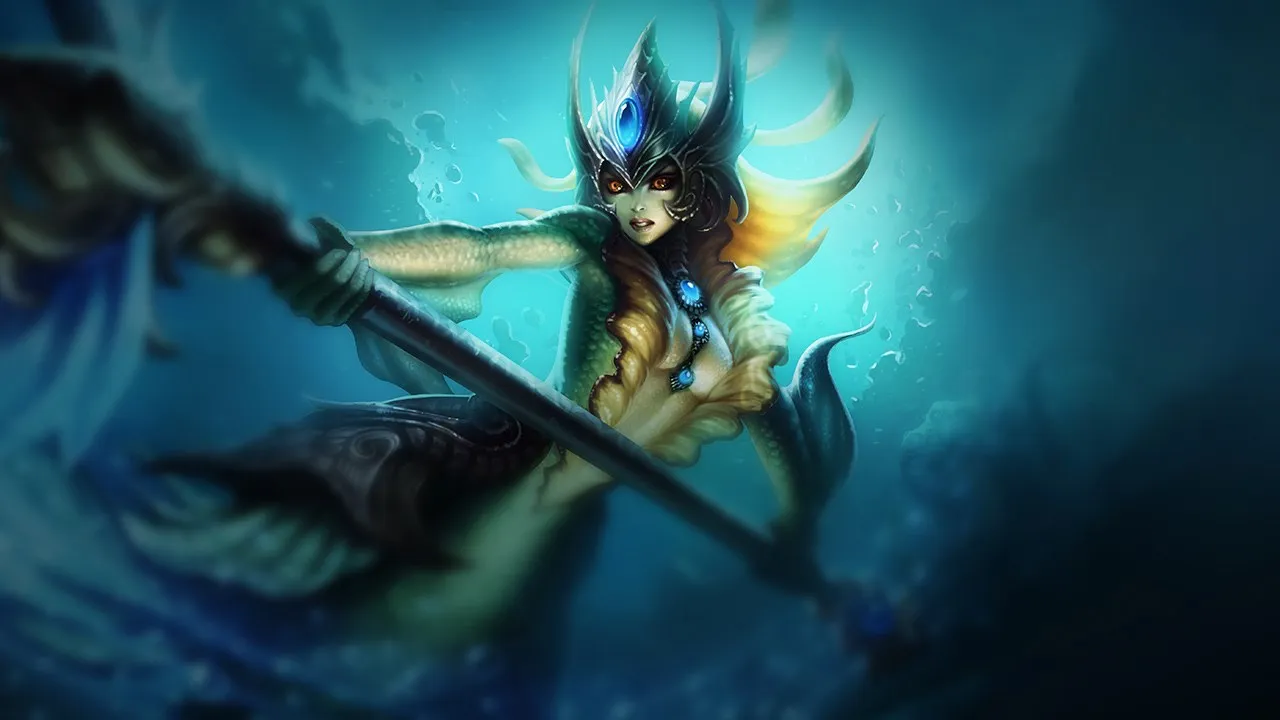
Nami is exposed against aggressive engage compositions that don't give her time to place heals and CC. Her lack of mobility makes her vulnerable to picks and frontal dives. Fast burst compositions neutralize her healing before it has impact.
★ SUPPORTTier S
DMG
UTIL
TANK
DIFF
Win50.4%#35 · ↑3pt
Pick4.5%#17
Ban0.1%#136
Nami Wild Rift Counters Guide
Hard Counters
1
These champions have a build and playstyle that directly overpower yours, which can make controlling the lane and farming extremely difficult. Their kit can neutralize your core strengths or punish you the moment you try to play your usual game plan. In these matchups, the goal is often to minimize mistakes and look for ways to win outside of direct confrontation.
PeelDisengagePyke dominates this lane because his lethal all-in potential heavily punishes your squishy nature. If he lands Bone Skewer, his immediate follow-up with Phantom Undertow guarantees a deadly crowd control chain that sets up Death from Below. However, his linear forward dash during Phantom Undertow creates a predictable trajectory. This trajectory is your only saving grace, allowing you to intercept his advance with a perfectly placed Aqua Prison.Pyke build →See details
Pyke
The interaction that decides it
Nami can use Aqua Prison on Pyke's predictable Phantom Undertow dash path to stop his stun chain.
Why
Pyke dominates this lane because his lethal all-in potential heavily punishes your squishy nature. If he lands Bone Skewer, his immediate follow-up with Phantom Undertow guarantees a deadly crowd control chain that sets up Death from Below. However, his linear forward dash during Phantom Undertow creates a predictable trajectory. This trajectory is your only saving grace, allowing you to intercept his advance with a perfectly placed Aqua Prison.
Lane impact
You cannot contest wave control early, as stepping up to use Ebb and Flow exposes you to a bush-charged Bone Skewer. This forces you to play defensively under turret, sacrificing priority and letting Pyke roam with Ghostwater Dive. If he burns his key displacement tools and misses, you gain a brief fifteen-second window to safely poke with Tidecaller's Blessing before his deadly threat profile resets.
How to play
Never cast Aqua Prison proactively; you must hold this spell exclusively to disrupt Pyke's engage. When you see him charge Bone Skewer or activate Ghostwater Dive, immediately retreat toward your ADC to share the movement speed from Surging Tides. If he commits to Phantom Undertow, drop your bubble directly along his dash path to stun him mid-air. Should you miss, immediately drop Tidal Wave to zone him out and prevent his lethal ultimate reset.
These champions have tools that generally give them the edge in a fight, without making the matchup unwinnable. They might have more range, a better ability to soak up your offense, or more ways to answer your engages. You'll need to adapt your approach and carefully pick your moments to accept a fight.
Early pressurePositioningZyra dominates this lane because her Rampant Growth seeds blossom into plants that physically obstruct Nami's pathing, making it incredibly easy for her to land Grasping Roots. However, Nami has a unique tool to fight back: these very same plants serve as perfect bounce targets for Ebb and Flow, allowing Nami to heal her ADC or poke Zyra even when Zyra stands safely behind her thorny summoned army.Zyra build →See details
Zyra
The interaction that decides it
Zyra's Rampant Growth plants block Nami's pathing, but Nami can bounce Ebb and Flow off the plants to heal allies or damage Zyra.
Why
Zyra dominates this lane because her Rampant Growth seeds blossom into plants that physically obstruct Nami's pathing, making it incredibly easy for her to land Grasping Roots. However, Nami has a unique tool to fight back: these very same plants serve as perfect bounce targets for Ebb and Flow, allowing Nami to heal her ADC or poke Zyra even when Zyra stands safely behind her thorny summoned army.
Lane impact
Zyra's Deadly Spines and plant spit push the wave constantly, trapping Nami under tower where dodging Stranglethorns becomes a nightmare. If Nami gets trapped by Grasping Roots while trying to secure space, the burst damage from the plants will force an early recall. This constant threat prevents Nami from easily roaming, keeping her locked in lane while Zyra chips away at tower plates and controls the brush.
How to play
Never walk directly toward Zyra's plants, as their collision pathing will trap you. Instead, position yourself parallel to them, using Surging Tides speed boosts to bait out Grasping Roots. Keep Aqua Prison locked and charged; never use it defensively on plants, but rather hold it to interrupt Zyra if she steps forward to trigger Stranglethorns. If you are pushed too far back, use Tidecaller's Blessing on your carry and bounce Ebb and Flow off the nearest plant to safely trade from afar.
Counter-engageAssassinThis matchup is dictated by the constant threat of Blitzcrank's Rocket Grab, which can instantly delete you due to your fragile pool of health. However, if Rocket Grab pulls you or your carry, you can immediately cast Aqua Prison onto the opposing marksman. Because the enemy shooter must stand still to follow up with damage, they become an easy target, allowing Ebb and Flow to bounce back and heal the damage.Blitzcrank build →See details
Blitzcrank
The interaction that decides it
Nami can counter-engage with Aqua Prison on the enemy ADC when Blitzcrank lands a hook, turning the trade around.
Why
This matchup is dictated by the constant threat of Blitzcrank's Rocket Grab, which can instantly delete you due to your fragile pool of health. However, if Rocket Grab pulls you or your carry, you can immediately cast Aqua Prison onto the opposing marksman. Because the enemy shooter must stand still to follow up with damage, they become an easy target, allowing Ebb and Flow to bounce back and heal the damage.
Lane impact
Because missing a single hook can cost the enemy team all pressure, Blitzcrank will try to zone you away from the wave. You cannot easily step up to poke with Ebb and Flow without risking a lethal grab. Consequently, your wave will often get pushed under tower, forcing you to farm defensively while watching for sneaky hooks through wall gaps or under your own turret during recall attempts.
How to play
Always stand behind your minions to block Rocket Grab, but keep your cursor ready to react. The moment Blitzcrank misses his hook, you have a fifteen-second window to play aggressively: immediately buff your ally with Tidecaller's Blessing, trigger Surging Tides for a speed boost, and poke them down. If you get caught near walls, unleash Tidal Wave to knock back both opponents and secure your escape before Power Fist can chain-CC you.
Early pressureCounter-engageLeona excels at capitalizing on your fragile defensive stats by bypassing your crowd control. The primary danger stems from Zenith Blade; if she connects this root, its instant dash brings her close enough to chain Shield of Daybreak before you can complete the windup animation of Aqua Prison. This lockdown allows her partner to trigger Sunlight marks, shredding your health bar before you can self-peel with Ebb and Flow.Leona build →See details
Leona
The interaction that decides it
If Leona lands Zenith Blade on Nami, she can lock her down before Nami can cast Aqua Prison to peel.
Why
Leona excels at capitalizing on your fragile defensive stats by bypassing your crowd control. The primary danger stems from Zenith Blade; if she connects this root, its instant dash brings her close enough to chain Shield of Daybreak before you can complete the windup animation of Aqua Prison. This lockdown allows her partner to trigger Sunlight marks, shredding your health bar before you can self-peel with Ebb and Flow.
Lane impact
This constant threat forces you to play defensively behind your minions, conceding bush control. If Leona steps forward with Eclipse active, you must retreat, which surrenders lane priority and allows her to secure easy tower pressure. An early mistake means getting burst down instantly, forcing a premature recall that leaves your marksman vulnerable to dive setups under tower when Solar Flare is available.
How to play
Maintain a strict diagonal positioning behind your minion wave, keeping maximum distance to make Zenith Blade easy to reactively dodge. Never step into bushes where she can hide. If she misses her Zenith Blade, immediately punish her with Ebb and Flow and Tidecaller's Blessing empowered basic attacks while her gap-closer is on cooldown. Save Tidal Wave to disrupt her follow-up engage if she targets your ADC instead of you.
Early pressurePositioningSenna naturally outscales you because her Basic Attack allows her to gather infinite range and stats through souls. This creates a severe scaling gap where she eventually out-ranges your abilities. However, the matchup remains playable because Senna must constantly step forward to collect these souls or to poke with Piercing Darkness. This predictable movement path exposes her to your crowd control, preventing her from dominating the lane for free.Senna build →See details
Senna
The interaction that decides it
Nami can use Tidecaller's Blessing to slow Senna when she steps up to collect souls, making her an easy target for Aqua Prison.
Why
Senna naturally outscales you because her Basic Attack allows her to gather infinite range and stats through souls. This creates a severe scaling gap where she eventually out-ranges your abilities. However, the matchup remains playable because Senna must constantly step forward to collect these souls or to poke with Piercing Darkness. This predictable movement path exposes her to your crowd control, preventing her from dominating the lane for free.
Lane impact
During the laning phase, Senna's Piercing Darkness neutralizes your Ebb and Flow harass by healing herself and her carry while damaging you. This makes mindless trading highly inefficient. If you allow her to collect souls freely, her increased range will push you under tower, leaving you vulnerable to Last Embrace setups. You will struggle to maintain wave control if you let her poke you down without retaliation.
How to play
To survive and win trades, watch the souls dropping from minions. The instant Senna steps up to harvest one, cast Tidecaller's Blessing on yourself or your marksman to slow her with an attack. Use this slow immediately to guarantee your Aqua Prison hits her while she is briefly stationary. If she tries to escape using Curse of the Black Mist, disengage or prepare Tidal Wave to disrupt her movement and force a flash.
SustainTeamfightsSona outpaces you as the match progresses because her Aria of Perseverance provides relentless team-wide sustain that your bounce-restricted Ebb and Flow cannot match. While you have stronger early lane control, Sona’s ability to continuously cycle basic spells to trigger devastating Power Chord effects creates a massive scaling disparity. To win, you must shut down her teamfight positioning using Tidal Wave before she can sustain her allies.Sona build →See details
Sona
The interaction that decides it
Nami must use Tidal Wave to disrupt Sona's teamfight positioning before Sona can freely cycle Aria of Perseverance.
Why
Sona outpaces you as the match progresses because her Aria of Perseverance provides relentless team-wide sustain that your bounce-restricted Ebb and Flow cannot match. While you have stronger early lane control, Sona’s ability to continuously cycle basic spells to trigger devastating Power Chord effects creates a massive scaling disparity. To win, you must shut down her teamfight positioning using Tidal Wave before she can sustain her allies.
Lane impact
Early on, you can force short trades with Ebb and Flow and Tidecaller's Blessing, but Sona’s Aria of Perseverance nullifies your poke if you fail to burst her down. As she scales, passive play plays into her hands, and missed Aqua Prison bubbles leave you highly vulnerable. Once ultimates are unlocked, Sona can easily turn any overextension into a disaster using Crescendo, locking down your lane partner.
How to play
Your priority is keeping Tidal Wave ready for the exact moment Sona groups with her team. Launch it to disrupt her positioning and force her to relocate, preventing her from cycling Aria of Perseverance freely. Never throw Aqua Prison blindly while her Song of Celerity is active, as she will easily dodge it. Instead, empower your carry with Tidecaller's Blessing to apply slows, making Sona an easier target for your knock-up.
PeelDisengageNautilus dominates the space with Dredge Line, threatening to pull you or your ADC into a deadly Staggering Blow chain. While Nami struggles to poke safely against his Titan's Wrath shield, her saving grace is Tidal Wave. When Nautilus commits with his anchor, Nami can cast her ultimate directly down his engage path to disrupt his follow-up and protect her carry.Nautilus build →See details
Nautilus
The interaction that decides it
Nami can use Tidal Wave to counter-engage and peel her ADC when Nautilus lands Dredge Line.
Why
Nautilus dominates the space with Dredge Line, threatening to pull you or your ADC into a deadly Staggering Blow chain. While Nami struggles to poke safely against his Titan's Wrath shield, her saving grace is Tidal Wave. When Nautilus commits with his anchor, Nami can cast her ultimate directly down his engage path to disrupt his follow-up and protect her carry.
Lane impact
This threat forces Nami and her partner to play defensively behind minions, conceding early brush control. If Nautilus lands Dredge Line before level five, the burst from Titan's Wrath and Riptide usually results in a forced recall or a kill. Once ultimate abilities are unlocked, any aggressive hook from Nautilus can be turned into a counter-attack, preventing him from easily diving under your turret or freezing the lane.
How to play
Position yourself strictly behind the minion wave, using Ebb and Flow only when Nautilus wastes his Dredge Line or when he steps too far forward to trigger Staggering Blow on minions. You must hold Tidal Wave exclusively for his engage; do not use it to start fights. If he hooks your ally, immediately cast Tidal Wave through the clash, then follow up with Aqua Prison on the stationary Nautilus and empower your ADC with Tidecaller's Blessing to turn the trade.
These matchups are above all duels of execution: both champions have credible ways to gain the upper hand. Dodging one key ability, anticipating an engage correctly, or a single positioning mistake can be enough to tip the duel one way or the other. Knowing the matchup and recognizing the right windows to act are especially important here.
SustainCrowd controlThis even matchup hinges on how Nami handles Galio's engage tools. While Galio tries to lock you down, his self-slowing Shield of Durand channel makes him an incredibly easy target for your Aqua Prison. By interrupting his taunt build-up from a safe distance, you completely shut down his primary crowd control tool, turning his aggressive dive into a stalled, punishable positioning error.Galio build →See details
Galio
The interaction that decides it
Nami can bubble Galio with Aqua Prison when he charges Shield of Durand, neutralizing his engage threat.
Why
This even matchup hinges on how Nami handles Galio's engage tools. While Galio tries to lock you down, his self-slowing Shield of Durand channel makes him an incredibly easy target for your Aqua Prison. By interrupting his taunt build-up from a safe distance, you completely shut down his primary crowd control tool, turning his aggressive dive into a stalled, punishable positioning error.
Lane impact
The laning phase swings heavily around these engagement windows. If you land your bubble during his charge, Galio's ADC is left without follow-up, allowing you to turn the fight with Ebb and Flow and Tidecaller's Blessing for heavy counter-damage. However, missing your CC leaves you vulnerable to a devastating Justice Punch and Winds of War combo, instantly stripping away your sustain advantage and forcing a defensive recall.
How to play
Never throw Aqua Prison proactively to poke. Save it exclusively for the moment Galio begins channeling Shield of Durand or winds up Justice Punch. When he moves forward, use the bonus movement speed from Surging Tides to stay just out of his melee range. If he manages to land Hero's Entrance on your partner, immediately cast Tidal Wave to disengage the fight, resetting the spacing so you can safely resume poking him down with basic attacks.
PokeEarly pressureThis matchup is a balancing act between Alistar's aggressive dive and your ability to mitigate it through positioning and sustain. While Alistar relies on Headbutt and Pulverize to force hard engages, Nami can neutralize the threat by targeting his ADC with Aqua Prison. This splits the enemy's focus, offsetting their burst damage with Ebb and Flow while Alistar's Triumphant Roar tries to keep them healthy.Alistar build →See details
Alistar
The interaction that decides it
Nami can bubble Alistar's ADC with Aqua Prison when Alistar engages, turning his dive into a split-focus trade.
Why
This matchup is a balancing act between Alistar's aggressive dive and your ability to mitigate it through positioning and sustain. While Alistar relies on Headbutt and Pulverize to force hard engages, Nami can neutralize the threat by targeting his ADC with Aqua Prison. This splits the enemy's focus, offsetting their burst damage with Ebb and Flow while Alistar's Triumphant Roar tries to keep them healthy.
Lane impact
Because both supports possess strong healing, the lane becomes a war of attrition. Alistar's presence prevents you from walking up blindly, forcing a cautious wave state. If Alistar misses his combo, you can punish him with Tidecaller's Blessing empowered attacks. However, a successful dive can quickly chunk your carry, meaning health bars fluctuate constantly until someone runs out of mana or gets caught by Tidal Wave.
How to play
Position yourself slightly behind your ADC, maintaining just enough distance to avoid getting caught in a double Pulverize. Never waste Aqua Prison on Alistar himself, especially when his Unbreakable Will is available. Instead, the moment you see him use Headbutt on your ally, immediately launch your bubble at the enemy marksman. If you miss, immediately activate Tidecaller's Blessing and use Ebb and Flow defensively to speed up your retreat.
Projectile blockDisengageThis lane centers on a direct interaction between shield and bubble. Braum's Unbreakable completely nullifies the massive projectile of Tidal Wave, neutralizing your primary engage or disengage tool. However, because Aqua Prison is a ground-targeted area-of-effect crowd control rather than a standard projectile, Braum cannot block it with his shield, leaving him and his nearby ally vulnerable to being suspended in the air.Braum build →See details
Braum
The interaction that decides it
Braum's Unbreakable can block Nami's Tidal Wave entirely, but he remains vulnerable to her ground-targeted Aqua Prison bubble.
Why
This lane centers on a direct interaction between shield and bubble. Braum's Unbreakable completely nullifies the massive projectile of Tidal Wave, neutralizing your primary engage or disengage tool. However, because Aqua Prison is a ground-targeted area-of-effect crowd control rather than a standard projectile, Braum cannot block it with his shield, leaving him and his nearby ally vulnerable to being suspended in the air.
Lane impact
The threat of Winter's Bite forces you to stand behind minions, slowing down your Ebb and Flow poke. If Braum uses Stand Behind Me to jump forward, the lane dynamic shifts instantly. Missed bubbles mean Braum can walk up with his shield, forcing your ADC off the wave and securing bush control, which drastically delays your team's rotation to early river skirmishes.
How to play
Never cast Tidal Wave raw while Braum has Unbreakable off cooldown. Instead, bait his shield by buffing your marksman with Tidecaller's Blessing to apply pressure. Once he raises his wall to block the empowered attacks, aim Aqua Prison directly behind his shield where he is locked in direction. If you get hit by Winter's Bite, immediately use Surging Tides speed boosts to retreat before he can stack Concussive Blows.
DuelingTradingMechanicsThis enchanter duel revolves around a direct speed check. Janna's passive Tailwind provides her marksman with just enough passive movement speed to easily sidestep your Aqua Prison. However, Janna cannot easily shield against your Ebb and Flow bounce trades, as the healing-to-damage bounces bypass the physical damage focus of her Eye of the Storm. It is a constant battle of prediction versus guaranteed targeted poke.Janna build →See details
Janna
The interaction that decides it
Janna can use the movement speed from Tailwind to help her ADC dodge Aqua Prison, but must watch out for Nami's Ebb and Flow bounce trades.
Why
This enchanter duel revolves around a direct speed check. Janna's passive Tailwind provides her marksman with just enough passive movement speed to easily sidestep your Aqua Prison. However, Janna cannot easily shield against your Ebb and Flow bounce trades, as the healing-to-damage bounces bypass the physical damage focus of her Eye of the Storm. It is a constant battle of prediction versus guaranteed targeted poke.
Lane impact
Neither support can easily force a hard engage, turning the lane into a war of attrition. Janna will try to disrupt your ADC's farming with Zephyr while keeping a fully charged Howling Gale ready to stop any forward movement. If you miss Aqua Prison, Janna immediately gains lane priority, allowing her to shield her ally and push you under tower. Safe, calculated short trades are what decide the recall timings here.
How to play
Stop leading with Aqua Prison; instead, cast Tidecaller's Blessing on yourself or your marksman to slow them down first. Wait for Janna to waste her Eye of the Storm before unleashing Ebb and Flow to ensure your damage sticks. When Janna channels Monsoon to disengage, immediately respond with Tidal Wave from maximum distance to disrupt her healing zone while triggering your Surging Tides to help your team close the gap safely.
SustainCounter-engageThis is a pure trade matchup where Nami's lane sustain clashes with Bard's map utility. The critical tension arises from how their ultimates interact. When Nami casts Tidal Wave to engage, Bard can instantly negate the momentum by placing Tempered Fate on her advancing allies. Furthermore, if Nami attempts to catch Bard out near walls, he can slip away instantly using Magical Journey.Bard build →See details
Bard
The interaction that decides it
Bard can use Magical Journey to escape Nami's Tidal Wave or use Tempered Fate to freeze her team during her engage.
Why
This is a pure trade matchup where Nami's lane sustain clashes with Bard's map utility. The critical tension arises from how their ultimates interact. When Nami casts Tidal Wave to engage, Bard can instantly negate the momentum by placing Tempered Fate on her advancing allies. Furthermore, if Nami attempts to catch Bard out near walls, he can slip away instantly using Magical Journey.
Lane impact
In the early levels, trades are highly dynamic. You must balance using Ebb and Flow to bounce damage and healing while dodging his Cosmic Binding angles near minions. Because Bard roams to collect chimes from Traveler’s Call, the lane pressure fluctuates constantly. If he leaves, you can push, but his ability to return via Magical Journey with his jungler means you are never truly safe under their tower.
How to play
To win this skill matchup, never initiate with Tidal Wave if Bard has Tempered Fate available; instead, use it as a counter-engage tool when his team commits. Position yourself in the center of the lane away from terrain to deny him easy stuns with Cosmic Binding. If you see him open a Magical Journey, immediately prep your Aqua Prison at the exit portal to trap anyone coming through, turning his escape tool into a death trap.
TradingCC immunityThis matchup is a balanced battle of attrition. While your ultimate, Tidal Wave, is normally a decisive tool, Milio can instantly negate its knock-up and slow with Breath of Life. However, Nami holds the upper hand in short-range trades. By utilizing Ebb and Flow, you can bounce healing and damage between targets, forcing Milio to exhaust Warm Hugs or Cozy Campfire to match your persistent health regeneration.Milio build →See details
Milio
The interaction that decides it
Milio can use Breath of Life to neutralize the knock-up from Tidal Wave, but must watch out for Nami's Ebb and Flow bounce trades in lane.
Why
This matchup is a balanced battle of attrition. While your ultimate, Tidal Wave, is normally a decisive tool, Milio can instantly negate its knock-up and slow with Breath of Life. However, Nami holds the upper hand in short-range trades. By utilizing Ebb and Flow, you can bounce healing and damage between targets, forcing Milio to exhaust Warm Hugs or Cozy Campfire to match your persistent health regeneration.
Lane impact
Laning revolves around continuous trading loops rather than explosive all-ins. Because Cozy Campfire and Warm Hugs have long cooldowns, your goal is to bait these defensive spells. If Milio wastes them, your AD carry can abuse their temporary range disadvantage. If you trade recklessly when Ebb and Flow is down, Milio's Fired Up! passive will slowly chip away at your health bar, leading to a lost lane priority.
How to play
To win this skill matchup, never initiate fights with Tidal Wave unless you have already forced Milio to use Breath of Life. Instead, apply Tidecaller's Blessing to your marksman to slow the enemies, making it easier to land Aqua Prison. When Milio steps forward to poke, immediately counter with Ebb and Flow to secure a double bounce. If you miss your bubble, retreat slightly until your healing cycle is ready again.
TradingDisengageThis matchup is a high-stakes duel of reflexes centered on Morgana's Black Shield. While this barrier completely nullifies your Aqua Prison, you can exploit its long cooldown. By bouncing Ebb and Flow off her or her carry, you often force an anxious Morgana to waste her spell shield early. Once her protective shield is down, you have a massive window to land your bubble.Morgana build →See details
Morgana
The interaction that decides it
Black Shield can block Aqua Prison, but Nami can bait it out with Ebb and Flow bounces before committing her crowd control.
Why
This matchup is a high-stakes duel of reflexes centered on Morgana's Black Shield. While this barrier completely nullifies your Aqua Prison, you can exploit its long cooldown. By bouncing Ebb and Flow off her or her carry, you often force an anxious Morgana to waste her spell shield early. Once her protective shield is down, you have a massive window to land your bubble.
Lane impact
The lane oscillates rapidly based on missed skillshots. If Morgana misses Dark Binding, her pressure vanishes, allowing you to use Surging Tides to aggressively poke with Tidecaller's Blessing. However, if she lands Dark Binding on your carry and follows with Tormented Shadow, you are forced to heal defensively with Ebb and Flow rather than using it to pressure.
How to play
Never cast Aqua Prison directly at a target who has Black Shield ready. Instead, use Tidecaller's Blessing on your shooter to slow them down, then bounce Ebb and Flow to create visual panic. If Morgana panics and shields, wait out the duration before throwing your bubble. If you get caught by Soul Shackles, immediately use Tidal Wave to knock her back and break the tether before the stun triggers.
SustainPositioningThis matchup is a pure test of micro-positioning and reaction speeds in a constant trade of spells. Seraphine wants to clip you and your carry with her slow-moving High Note and Beat Drop to set up her crowd control. However, your passive Surging Tides is the perfect counter-mechanism. By tagging your ADC with any spell, the sudden burst of movement speed lets them easily sidestep her linear, sluggish projectiles.Seraphine build →See details
Seraphine
The interaction that decides it
Nami's Surging Tides passive helps allies dodge Seraphine's slow-moving High Note and Beat Drop.
Why
This matchup is a pure test of micro-positioning and reaction speeds in a constant trade of spells. Seraphine wants to clip you and your carry with her slow-moving High Note and Beat Drop to set up her crowd control. However, your passive Surging Tides is the perfect counter-mechanism. By tagging your ADC with any spell, the sudden burst of movement speed lets them easily sidestep her linear, sluggish projectiles.
Lane impact
Because both of you possess heavy area-of-effect poke, the lane state is highly volatile. If Seraphine misses her double-cast spells, she leaves her ADC vulnerable. You can immediately punish her with Ebb and Flow for efficient health trades. If you fail to utilize your movement speed buffs, she will push you under turret, using Surround Sound to shrug off your retaliation and force early recalls.
How to play
Stay spread out from your carry to prevent Seraphine from hitting you both with Encore or a double Beat Drop. Keep Tidecaller's Blessing ready; apply it to your ADC the moment you see Seraphine start her casting animation so they can dodge and counter-attack. If you get caught by her crowd control, immediately use Tidal Wave to disengage the fight, or launch Aqua Prison directly onto her to disrupt her follow-up damage.
PeelDisengageThis matchup is a pure battle of reaction times. While Thresh seeks to isolate your ADC with Death Sentence, your kit allows you to disrupt his follow-up. The ultimate swing factor is how you respond to his lantern; casting Aqua Prison directly on top of Dark Passage allows you to bubble his clicking ally the exact millisecond they arrive, turning his escape tool into a deadly trap.Thresh build →See details
Thresh
The interaction that decides it
Nami can throw Aqua Prison directly onto Thresh's Dark Passage lantern to catch the incoming ally as they arrive.
Why
This matchup is a pure battle of reaction times. While Thresh seeks to isolate your ADC with Death Sentence, your kit allows you to disrupt his follow-up. The ultimate swing factor is how you respond to his lantern; casting Aqua Prison directly on top of Dark Passage allows you to bubble his clicking ally the exact millisecond they arrive, turning his escape tool into a deadly trap.
Lane impact
Consequently, the lane becomes a high-stakes spacing game. You can dominate early trades using Ebb and Flow and Tidecaller's Blessing to wear him down, provided you stand safely behind minions. If Thresh misses Death Sentence, you gain total lane control. However, missing your Aqua Prison invites him to step up aggressively, trap you with The Box, and sweep your ADC with Flay.
How to play
Always position yourself diagonally from Thresh, keeping a wave between you to block Death Sentence. Never throw Aqua Prison blindly; save it for when he commits. The moment you see his Dark Passage lantern hit the ground, immediately cast your bubble on it. If his ally takes the ride, they are guaranteed to get CC'd. Should Thresh manage to close the gap on you instead, drop Tidal Wave to knock him back and trigger Surging Tides for a swift retreat.
SustainAnti-healThis matchup is a pure battle of attrition where your Ebb and Flow bounces constantly clash with Soraka's endless Astral Infusion heals. Because Soraka can easily negate your poke from safety, the lane remains entirely even unless you disrupt her directly. Her ability to regenerate health via Starcall makes targeting her carry useless; you must target her to stop the healing cycle.Soraka build →See details
Soraka
The interaction that decides it
Nami needs to land Aqua Prison on Soraka herself to stop her from safely casting Astral Infusion from the backline.
Why
This matchup is a pure battle of attrition where your Ebb and Flow bounces constantly clash with Soraka's endless Astral Infusion heals. Because Soraka can easily negate your poke from safety, the lane remains entirely even unless you disrupt her directly. Her ability to regenerate health via Starcall makes targeting her carry useless; you must target her to stop the healing cycle.
Lane impact
Constant health bar fluctuations define this lane, leading to drawn-out skirmishes rather than quick burst kills. If you focus your trades on the enemy marksman, Soraka simply uses Astral Infusion to erase your damage, while her Equinox zone prevents you from chasing. This creates a stalemate where neither duo can easily push for tower plates, forcing both of you to stay in lane much longer before recalling.
How to play
To break this loop, alter your normal build path immediately to prioritize early healing reduction, weakening her Wish and Astral Infusion. In skirmishes, resist the urge to throw Aqua Prison at the opposing marksman. Instead, hold this bubble specifically for Soraka when she steps forward to aim Starcall. Catching her prevents her from retreating, allowing you to follow up with Tidal Wave and Tidecaller's Blessing to secure a decisive shutdown.
BurstCounter-engageThis matchup is a constant battle of trade windows. Malphite relies on his passive Granite Shield to absorb poke while using Seismic Shard to harass your ADC. However, Nami can easily mitigate this damage with Ebb and Flow. The lane's ultimate outcome hinges on Unstoppable Force. If Malphite's ultimate fails to burst down your partner instantly, your Tidal Wave serves as the perfect counter-engage tool to reset the fight.Malphite build →See details
Malphite
The interaction that decides it
Nami can use Tidal Wave to counter-engage and peel her ADC if Malphite's Unstoppable Force fails to secure an immediate kill.
Why
This matchup is a constant battle of trade windows. Malphite relies on his passive Granite Shield to absorb poke while using Seismic Shard to harass your ADC. However, Nami can easily mitigate this damage with Ebb and Flow. The lane's ultimate outcome hinges on Unstoppable Force. If Malphite's ultimate fails to burst down your partner instantly, your Tidal Wave serves as the perfect counter-engage tool to reset the fight.
Lane impact
Before level five, you can aggressively punish Malphite's melee nature with Tidecaller's Blessing empowered attacks. However, once he unlocks Unstoppable Force, the lane dynamic completely flips. You cannot afford to push deep. An overextended wave invites a deadly dive, where his Ground Slam will cripple your ADC's return damage. Keeping the wave neutral forces Malphite into desperate, predictable ultimate attempts.
How to play
To survive, maintain a diagonal positioning offset from your ADC; never stand close enough for Malphite to hit both of you with Unstoppable Force. Always hold Tidal Wave as a reactive tool. When he dashes in on your partner, immediately launch your wave in his path to disrupt his follow-up Thunderclap attacks. Follow this up with Aqua Prison on the locked-down rocky support while Surging Tides speeds your ADC to safety.
PeelDisengageThis matchup is a high-speed chess match between Rakan's sudden dashes and Nami's counter-engage. The entire lane revolves around Rakan's Grand Entrance. Because his jump has a brief delay, Nami can predict his landing spot. By dropping Aqua Prison directly onto her targeted ally, she nullifies his dive. Meanwhile, Rakan's Battle Dance allows him to escape, making timing and prediction the absolute deciding factors.Rakan build →See details
Rakan
The interaction that decides it
Nami can cast Aqua Prison on her ally's location to catch Rakan as he commits to Grand Entrance.
Why
This matchup is a high-speed chess match between Rakan's sudden dashes and Nami's counter-engage. The entire lane revolves around Rakan's Grand Entrance. Because his jump has a brief delay, Nami can predict his landing spot. By dropping Aqua Prison directly onto her targeted ally, she nullifies his dive. Meanwhile, Rakan's Battle Dance allows him to escape, making timing and prediction the absolute deciding factors.
Lane impact
Trades are explosive and highly mobile. If Rakan successfully lands Grand Entrance, his passive Fey Feathers and Gleaming Quill heal allow his duo to win the health trade and push the wave. However, if you interrupt his jump, he remains trapped under your minion aggro. This allows you to bounce Ebb and Flow for a massive health swing, forcing them to play defensively near their tower.
How to play
Never throw Aqua Prison randomly to poke. Keep your distance from your carry so you both do not get caught by the same Grand Entrance. When Rakan dashes forward, cast Aqua Prison directly on top of your ally's feet, not on Rakan's starting position. If he activates The Quickness, immediately respond with Tidal Wave to disrupt his movement speed and apply Tidecaller's Blessing to your carry to kite back safely.
PositioningDodgingThis matchup is a pure battle of ranges and reaction times. Lux will consistently try to poke you from safety using Lucent Singularity, which easily outranges your Ebb and Flow. However, because her cast animations commit her to a fixed spot, she is highly vulnerable to Aqua Prison. If she fails to dodge your bubble during these poke attempts, you can immediately turn her aggression into a lethal counter-engage.Lux build →See details
Lux
The interaction that decides it
Lux outranges Nami's Ebb and Flow with Lucent Singularity, but must dodge Aqua Prison to avoid being turned on during trades.
Why
This matchup is a pure battle of ranges and reaction times. Lux will consistently try to poke you from safety using Lucent Singularity, which easily outranges your Ebb and Flow. However, because her cast animations commit her to a fixed spot, she is highly vulnerable to Aqua Prison. If she fails to dodge your bubble during these poke attempts, you can immediately turn her aggression into a lethal counter-engage.
Lane impact
Expect a highly volatile trading war where lane priority swings with every missed skillshot. If Lux lands Lucent Singularity repeatedly, she will easily shove the wave and trap you under turret. Conversely, if you force her to miss, you can apply massive pressure with Tidecaller's Blessing. A single successful Aqua Prison on Lux or her carry completely halts their pushing power, while a missed bubble invites her to zone you.
How to play
To win this, use the bonus movement speed from Surging Tides to actively bait out her Lucent Singularity before looking for any trades. Never step forward to cast Ebb and Flow unless her main slow is on cooldown. Hold your Aqua Prison specifically for the moment she stands still to cast Light Binding or Prismatic Barrier. If she misses her binding, immediately activate Tidecaller's Blessing on your marksman and push her off the wave.
These champions generally struggle to answer your main strengths, which lets you approach the matchup with more freedom. You often have several ways to pressure them and force trades that go in your favor. Use this advantage to dictate the pace rather than giving them time to get back into a comfortable position.
TradingDisengageNami dominates this lane by turning short skirmishes into guaranteed health advantages. When Lulu attempts to shield herself or her carry with Help, Pix!, your Ebb and Flow completely bypasses this temporary defense by bouncing to heal your ally while simultaneously damaging the Yordle. This dual-action trading pattern outvalues Lulu's single-target utility, forcing her to bleed resources while you keep your carry healthy.Lulu build →See details
Lulu
The interaction that decides it
Nami's Ebb and Flow wins short trades by simultaneously healing her ally and damaging Lulu, bypassing Help, Pix! shields over time.
Why
Nami dominates this lane by turning short skirmishes into guaranteed health advantages. When Lulu attempts to shield herself or her carry with Help, Pix!, your Ebb and Flow completely bypasses this temporary defense by bouncing to heal your ally while simultaneously damaging the Yordle. This dual-action trading pattern outvalues Lulu's single-target utility, forcing her to bleed resources while you keep your carry healthy.
Lane impact
This superior sustain structure warps the laning phase into a slow squeeze. Lulu is forced to play defensively, fearing that aggressive uses of Glitterlance will leave her vulnerable to your bounces. Because you consistently win the health trades, you can keep the minion wave pushed, denying Lulu the safety of her tower. Her carry will constantly sit at low health, preventing them from contesting early river skirmishes.
How to play
Position yourself parallel to your carry to ensure Ebb and Flow always has a bounce target, keeping you within range to react to Lulu's movements. Hold your Aqua Prison until Lulu uses Whimsy on her ally; this makes her target predictable and unable to dodge. If she uses Wild Growth to save her partner, instantly counter with Tidal Wave to disengage the knock-up zone and reset your spacing before her bonus health fades.
TradingSustainThis matchup leans in your favor because Ebb and Flow naturally wins short, sharp exchanges. When Karma attempts to poke, your Ebb and Flow negates her damage through healing while simultaneously bouncing back to chip her health pool. Even if she buffers the damage with Inspire, she loses the trade efficiency unless she lands a precise Inner Flame, as her shield cannot match the dual-value swing of your bounce.Karma build →See details
Karma
The interaction that decides it
Nami's Ebb and Flow provides both damage and healing in short trades, which can out-value Karma's Inspire shield if Karma fails to land a clean Inner Flame.
Why
This matchup leans in your favor because Ebb and Flow naturally wins short, sharp exchanges. When Karma attempts to poke, your Ebb and Flow negates her damage through healing while simultaneously bouncing back to chip her health pool. Even if she buffers the damage with Inspire, she loses the trade efficiency unless she lands a precise Inner Flame, as her shield cannot match the dual-value swing of your bounce.
Lane impact
In practice, this dynamic allows you to establish early lane dominance. By maintaining a health lead through superior trade efficiency, you can slow-push waves or pressure Karma under her own tower. Her ADC will constantly be forced to play defensively, fearing your follow-up engage. This health advantage translates into early priority, giving your jungler uncontested scuttle crab control and forcing Karma to recall on awkward, resource-starved timings.
How to play
To secure this advantage, position yourself diagonally behind your minion wave to deny Karma a direct line of sight for Inner Flame. Wait for her to waste Inspire on herself or her carry, then immediately step forward to trigger Ebb and Flow. Always hold Aqua Prison as a disengage tool; if she tries to aggressively tether you with Focused Resolve, drop the bubble directly on her path to interrupt the link and easily win the extended skirmish.
PokeCounter-engageMaokai's engage is highly predictable because Twisted Advance forces him into a locked, untargetable travel path directly to his target. Since his destination is completely telegraphed, you can easily pre-cast Aqua Prison right on top of your targeted ally. The moment Maokai materializes to root them, he is instantly bubble-lifted, completely neutralizing his follow-up Bramble Smash and turning his engage into a death trap.Maokai build →See details
Maokai
The interaction that decides it
Nami can easily pre-cast Aqua Prison (Q) on her ally when she sees Maokai flying in with Twisted Advance (W).
Why
Maokai's engage is highly predictable because Twisted Advance forces him into a locked, untargetable travel path directly to his target. Since his destination is completely telegraphed, you can easily pre-cast Aqua Prison right on top of your targeted ally. The moment Maokai materializes to root them, he is instantly bubble-lifted, completely neutralizing his follow-up Bramble Smash and turning his engage into a death trap.
Lane impact
This predictable counter-play completely stifles Maokai's presence, allowing you to establish dominant bush control. Since he cannot safely use Twisted Advance without getting bubbled and poked out by Ebb and Flow, your marksman can safely push the wave. This pressure forces Maokai to bleed health trying to farm under tower, or waste Sapling Toss in lane bushes rather than using them for deep river vision.
How to play
Stand slightly behind your marksman, keeping them within your Ebb and Flow range but far enough to avoid Maokai's follow-up crowd control. Keep Aqua Prison strictly off cooldown when Maokai steps forward. The second you see the animation of Twisted Advance tracking your ally, drop your bubble directly on that ally's feet, then apply Tidecaller's Blessing to easily kite and punish him using Surging Tides.
SustainEarly pressureThis matchup revolves around punishing Yuumi's need to detach. To sustain her mana and provide shields, Yuumi must step off her host to trigger Bop 'n' Block. This is your cue. Landing Aqua Prison during this brief window of vulnerability is devastating, as the crowd control puts You and Me! on a long lockout cooldown, leaving the magical cat completely exposed and helpless.Yuumi build →See details
Yuumi
The interaction that decides it
Aqua Prison can easily catch Yuumi when she detaches to trigger Bop 'n' Block, putting her attach on a long cooldown.
Why
This matchup revolves around punishing Yuumi's need to detach. To sustain her mana and provide shields, Yuumi must step off her host to trigger Bop 'n' Block. This is your cue. Landing Aqua Prison during this brief window of vulnerability is devastating, as the crowd control puts You and Me! on a long lockout cooldown, leaving the magical cat completely exposed and helpless.
Lane impact
By threatening this bubble, you completely paralyze their laning phase. The enemy marksman is forced to play exceptionally safe, unable to count on Yuumi's aggressive positioning. If you successfully catch her out, you secure easy health trades with Ebb and Flow and establish dominant wave control. This pressure forces early recalls and allows you to chip away at their tower plates without fear of reprisal.
How to play
Never throw Aqua Prison blindly; hold it specifically for the moment Yuumi detaches to auto-attack. Position yourself parallel to her target, using Tidecaller's Blessing on yourself or your marksman to slow her if she tries to run back. If you miss your bubble, immediately back off and use Ebb and Flow to mitigate their retaliatory Prowling Projectile poke while your crowd control is offline.
PeelDisengageThis matchup is highly favorable because Rell's main engage features a highly telegraphed, slow aerial trajectory. By timing Aqua Prison right where she is about to land, you can interrupt her jump mid-air. This completely denies her crowd control, leaving her dismounted, extremely slow, and trapped in a vulnerable position where your marksman can easily melt her armor-depleted form.Rell build →See details
Rell
The interaction that decides it
Nami can easily interrupt Rell's jump engage with a well-timed Aqua Prison, leaving Rell dismounted and highly vulnerable.
Why
This matchup is highly favorable because Rell's main engage features a highly telegraphed, slow aerial trajectory. By timing Aqua Prison right where she is about to land, you can interrupt her jump mid-air. This completely denies her crowd control, leaving her dismounted, extremely slow, and trapped in a vulnerable position where your marksman can easily melt her armor-depleted form.
Lane impact
Because you hold the ultimate shutdown tool, the enemy duo is forced to play incredibly passive. Rell cannot step up to secure minion gold or threaten your marksman without risking a fatal counter-engage. This allows you to constantly harass them with Ebb and Flow bounces, establishing heavy lane priority and forcing them to drop farm under their own tower.
How to play
Never throw Aqua Prison defensively or to poke; keep it strictly reserved as a reaction to her jump. When she inevitably commits, bubble her landing spot, then immediately empower your ally with Tidecaller's Blessing to secure an easy counter-kill on the slow, dismounted tank. If she tries to catch you off-guard, deploy Tidal Wave immediately to wash away her momentum and safely reset the fight.
Edge: Wild Rift Core canonical verdict (−3 to +3), shown from the point of view of the champion named in the row. Win rate and pick rate: the opponent's own rate in this role — Wild Rift CN · Challenger, Patch 7.3c. Not a head-to-head win rate.
How to counter this champion
Counter angle
Nami’s counters are not just about damage or burst, but about denying her tempo. Any champion that can quickly engage, force repositioning, or punish positioning mistakes will heavily reduce her impact. Nami lacks reliable immediate survivability against direct engage—she relies on spacing and game reading. Understanding her counters means understanding how to disrupt her setup.
Patch context
In the current meta, engage supports and catch tools are very common. This creates a difficult environment for Nami, as she cannot afford positioning mistakes. Hooks, instant engages, and defensive shields reduce her ability to control trades. She remains viable, but only if she plays proactively. Any late reaction is usually punished immediately.
Quick read
Hooks and fast engages break her positioning.
Shields reduce her poke impact.
She relies too much on timing to survive engages.
Counter archetypes
Hook engage supports
These champions directly punish Nami’s main weakness: positioning. A successful hook removes her ability to control tempo entirely. She has no dash or tankiness to survive mistakes. Additionally, these supports force her to play further back, reducing her ability to poke or properly set up her E.
How the champion adapts. Play around hook cooldowns, maintain maximum distance, and use minions as protection.
Direct engage supports
These champions don’t rely on precise skillshots to engage. They can force fights instantly, preventing Nami from setting up her abilities. Since her kit is based on anticipation, she often reacts too late against this type of engage. Once caught, she has very limited survival tools without assistance.
How the champion adapts. Save R for disengage and never step forward without vision.
Shield poke supports
These champions neutralize Nami’s impact by reducing the value of her poke. Her trades rely on sustained damage and healing, but shields negate this pressure. Additionally, they can respond to her engages with repositioning or buffs, making her catch attempts less reliable.
Blitzcrank turns the lane into a patience game. One successful hook instantly removes Nami’s pressure. The matchup is not about damage but discipline: every step forward must be justified. If Nami forces too early, she loses. If she plays around cooldowns, she can regain control.
Leona does not give the luxury of waiting for mistakes—she forces fights. Nami must anticipate and play defensively. Any mispositioning becomes a forced engage. The matchup entirely depends on Nami’s ability to read engage timings.
Common mistakes against him
Common mistakes against him
Underestimating enemy engage timings.
Playing too close without vision.
Using Q proactively without safety.
Ignoring hook cooldowns.
Forcing extended trades into shields.
Coach notes
If you die with R available, it’s a reading mistake.
Your positioning matters more than your healing.
FAQ
How do you play against hooks?
Hook matchups are about discipline and timing. You must constantly play behind minions and track enemy cooldowns. Once the hook is used, you can regain pressure. Before that, every aggressive position is unnecessary risk. The goal is not to win lane fast, but to avoid losing it through a mistake.
Why do I get engaged on so easily?
This often comes from poor spacing. Nami must always play at max range, never within direct engage range. If you are too close, even perfect timing won’t save you. You need to accept losing some pressure to maintain safe positioning.
Can she play aggressively into her counters?
Yes, but only after forcing their key cooldowns. For example, once a hook is used, there is a real window to play aggressively. Without that, aggression is risky. Aggression must be conditional, not automatic.
What is the worst type of matchup for Nami?
Matchups combining direct engage and fast follow-up are the hardest. They reduce her reaction time and prevent her from using her anticipation-based kit. They are not always the strongest individually, but they punish every mistake instantly.